
Wednesday, June 13, 2012
Julian #Assange:Supreme Court Asked To Reopen Julian Assange Appeal
Submission by lawyers for the WikiLeaks founder states that justices ruled against him on legal point not argued in court
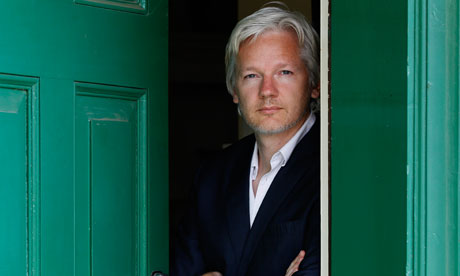
Julian Assangean can still take his case to the European court of human rights if he loses his latest appeal. Photograph: Peter Macdiarmid/Getty Images
Lawyers for the WikiLeaks founder Julian Assange have formally asked the supreme court to reopen his appeal against extradition to Sweden over alleged sex crimes. Their 18-page submission states that a majority of justices ruled against him on the basis of a legal point not argued in court. The highly unusual procedure revolves around the applicability of the Vienna convention on the law of treaties and whether a European arrest warrant can be issued by a prosecutor. The supreme court confirmed that it had received the application by Dinah Rose QC, Assange's barrister. It will now consider the written submission. It can then either reject the application to reopen the case, call for fresh written arguments, or decide to hold a second oral hearing. If Assange loses in the UK's supreme court, he can still take his case to the European court of human rights, further delaying the extradition process for many months.

Tuesday, June 5, 2012
Julian #Assange : EXCLUSIVE Interview With RT News.
https://twitter.com/#!/RT_com
With nothing else better to do, the FBI are shaking down all the people that Wikileaks' Julian Assange has interviewed on his RT tv show, trying to get them to squeal against Assange. A new low for the American government.
Recorded from RT, 05 June 2012.
Recorded from RT, 05 June 2012.
Sunday, June 3, 2012
#Assange : #US Vendetta Against Wikileaks.
http://www.guardian.co.uk/commentisfree/2012/may/31/americas-vendetta-against-wikileaks-julian-assange?CMP=twt_gu
• Denis Moynihan contributed research to this column
© Amy Goodman 2012; distributed by King Features Syndicate
As the contrast with the extradition case of Augusto Pinochet shows, it's one law for whistleblowers, another for war criminals

The UK supreme court gave Julian Assange 14 more days to fight his extradition to Sweden. Photograph: Kirsty Wigglesworth/AP
WikiLeaks founder Julian Assange's protracted effort to fight extradition to Sweden suffered a body blow this week. Britain's supreme court upheld the arrest warrant, issued in December 2010.
After the court announced its split 5-2 decision, the justices surprised many legal observers by granting Assange's lawyers an opportunity to challenge their decision – the first such reconsideration since the high-profile British extradition case from more than a decade ago against former Chilean dictator Augusto Pinochet. The decision came almost two years to the day after Private Bradley Manning was arrested in Iraq for allegedly leaking hundreds of thousands of classified US government documents to WikiLeaks.
Assange has not been charged with any crime, yet he has been under house arrest in England for close to two years, ever since a European arrest warrant was issued by Sweden (importantly, by a prosecutor, not by a judge). Hoping to question Assange, the prosecutor issued the warrant for suspicion of rape, unlawful coercion and sexual molestation. Assange offered to meet the Swedish authorities in their embassy in London, or in Scotland Yard, but was refused.
Assange and his supporters allege that the warrant is part of an attempt by the US government to imprison him, or even execute him, and to shut down WikiLeaks. In April 2010, WikiLeaks released a US military video under the title Collateral Murder, with graphic images showing an Apache helicopter unit killing at least 12 Iraqi civilians, including a Reuters cameraman and his driver. In July 2010, WikiLeaks released the Afghan war diary, tens of thousands of secret US military communications that laid out the official record of the violent occupation of Afghanistan, the scale of civilian deaths and likely war crimes. The Swedish arrest warrant followed just weeks later.
So many public figures have called for Assange's assassination that a website was created to catalogue the threats. Former Arkansas governor, presidential candidate and Fox News commentator Mike Huckabee said that, for Assange, "anything less than execution is too kind a penalty". Prominent conservative Bill Kristol asked:
"Why can't we use our various assets to harass, snatch or neutralize Julian Assange and his collaborators, wherever they are?"
Death threats from rightwing ideologues are one thing. The main concern with an extradition to Sweden is that Assange will then be extradited to the United States. In another prominent document released by WikiLeaks, called the Global Intelligence Files, a portion of up to 5m emails were released from a private, global intelligence firm called Stratfor, based in Austin, Texas. The firm's vice president for intelligence, Fred Burton, wrote in a 26 January 2011 email:
"Not for Pub – We have a sealed indictment on Assange. Pls protect."
If an indictment has been issued in secret, then Assange could find himself in US custody shortly after landing in Sweden. He could be charged with espionage (the Obama administration has already invoked the law more than all previous US administrations combined), and could be imprisoned for life or executed.
The United Kingdom carefully considers extradition requests, as famously demonstrated when crusading Spanish judge Baltasar Garzon hoped to prosecute former Chilean dictator Pinochet for torture committed under his rule from 1973 to 1990. Based on Garzon's indictment, Pinochet was arrested in 1998 while travelling in London. After 16 months of hearings, the British courts finally decided that Pinochet could be extradited to Spain. The British government intervened, overruling the court, and allowed him to return to Chile.
Garzon is known for taking on global human rights cases under the doctrine of universal jurisdiction, indicting Osama bin Laden for the 9/11 attacks and probing the abuse of US prisoners at Guantánamo Bay. When he began investigating abuses under the fascist government of general Francisco Franco, who ruled Spain for 40 years, Garzon became the target of the right in Spain and was disbarred in early 2012, effectively ending his legal career.
Judge Garzon and Julian Assange have taken on entrenched power, whether government, military or corporate. Bradley Manning stands accused of the same. In differing degrees, their lives have forever changed; their careers, their freedoms and their reputations were threatened or destroyed.
Why?
What role is the US government playing in Assange's case?
This week's developments bear crucially on the public's right to know, and why whistleblowers must be protected.
© Amy Goodman 2012; distributed by King Features Syndicate
Friday, June 1, 2012
#Assange: The Situation In #Sweden You Will Not Read In The Media.
http://watchingyouwatchingyme-steelmagnolia.blogspot.com.es/2010/12/assanga-and-situation-in-sweden.html

Read more: http://www.dailymail.co.uk/news/article-2152014/Julian-Assange-loses-extradition-appeal-WikiLeaks-boss-sent-Sweden-face-sex-crime-allegations.html#ixzz1wa79GNvT
Facing extradition: Julian Assange is now a step closer to being forced out of Britain after the Supreme Court decision to uphold previous rulings
Read more: http://www.dailymail.co.uk/news/article-2152014/Julian-Assange-loses-extradition-appeal-WikiLeaks-boss-sent-Sweden-face-sex-crime-allegations.html#ixzz1wa79GNvT
#Assange: #USA Censor UK Supreme Court Ruling .
The New York Times remove over half of its article on #Assange UK Supreme Court ruling without explanation.
Wednesday, May 30, 2012
#Extradition #Assange : Supreme Court Next Step.
Further statement
Julian Assange v Swedish Prosecution Authority
30 May 2012
Following this morning's judgment by the Supreme Court of the United Kingdom in Assange v The Swedish Prosecution Authority, Ms Rose (counsel for the appellant, Mr Assange) has indicated that she may make an application to re-open the Court's decision. Ms Rose suggested that the majority of the Court appear to have based their decision on the interpretation of the Vienna Convention on the Law of Treaties, on which no argument was heard.The Supreme Court has granted Ms Rose fourteen (14) days to make such an application. If she decides to do so, the Justices will then decide whether to re-open the appeal and accept further submissions (either verbally through a further hearing, or on paper) on the matter.
We will keep you updated on progress with this application and the Justices' consideration of any such application.
With the agreement of the respondent, the required period for extradition shall not commence until 13th June 2012, the 14th day after judgment in accordance with section 36(3)(b) of the Extradition Act 2003.
Follow on twitter.
https://twitter.com/#!/UKSupremeCourt
Subscribe to:
Posts (Atom)